
Working paper coming soon!
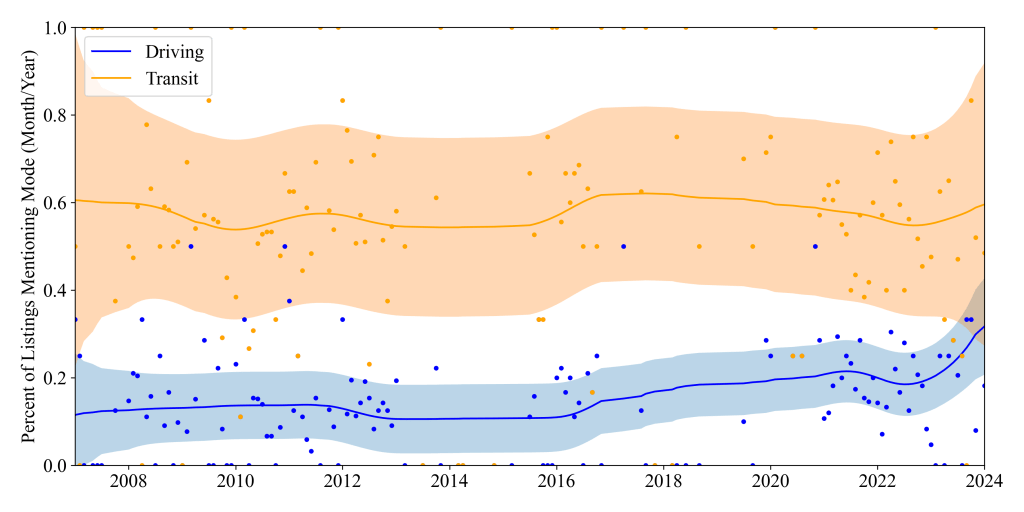
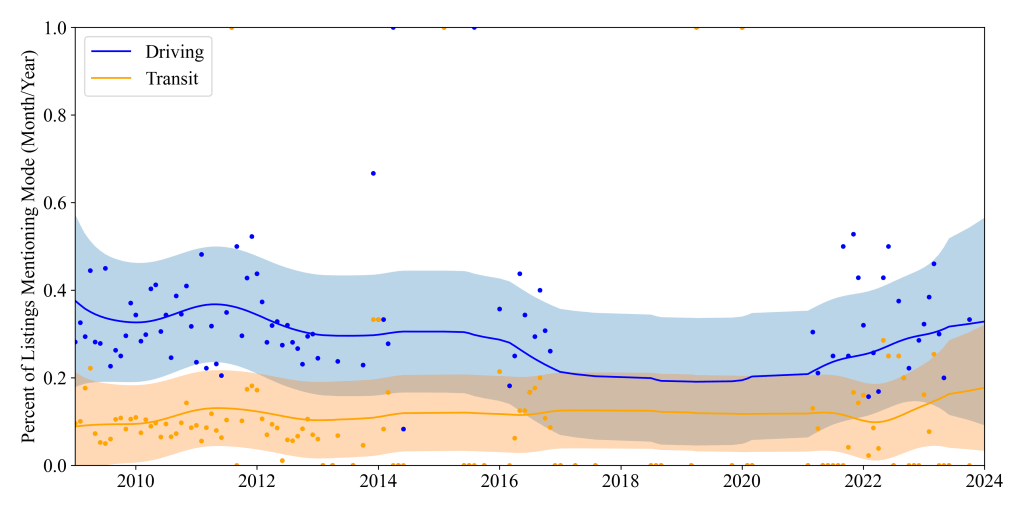
In North America, the widespread reliance on personal vehicles for mobility presents a significant challenge for climate change mitigation. Despite commitments to improve sustainable transportation networks, only 12% of US cities saw a decrease in personal vehicle dependence over the last 15 years. Changing individual behaviors around mode choice is notoriously difficult, but the behavioral science literature has identified an opportunity for intervention when people change home locations, therefore changing their routines. Little is known, however, about what signals people receive about the mobility culture of their new home location that may influence their inclination for change. Therefore, this paper asks: how does normative language around mode choice reflect shared perceptions of the mobility culture in a city? Drawing on two decades of archived online rental listings from two US cities with recent transit expansion projects but different mobility cultures, Boston and Phoenix, this study first extracts and analyzes language around transportation options through fine-tuned supervised BERT-based topic models and then uses a difference-in-differences approach to test the causal effect of transit network expansions on the frequency of transit mentions in listings. We find that Boston listings mention transit options more often than Phoenix, even when accounting for proximity to major transit stations. Additionally, we find a positive causal relationship in both cities between expanding the transit network and increased mentions of transit options in the immediate vicinity of the change, but not for the network as a whole. This suggests that normative signals about travel mode reinforce the dominant mobility behaviors irrespective of transit availability, however changes to the transport infrastructure can disrupt these norms. We argue that rental listings tell a story of a city’s mobility culture that is being presented to homeseekers at a critical transition time–when they are potentially most receptive to changing their travel behavior.
 Madison Lore